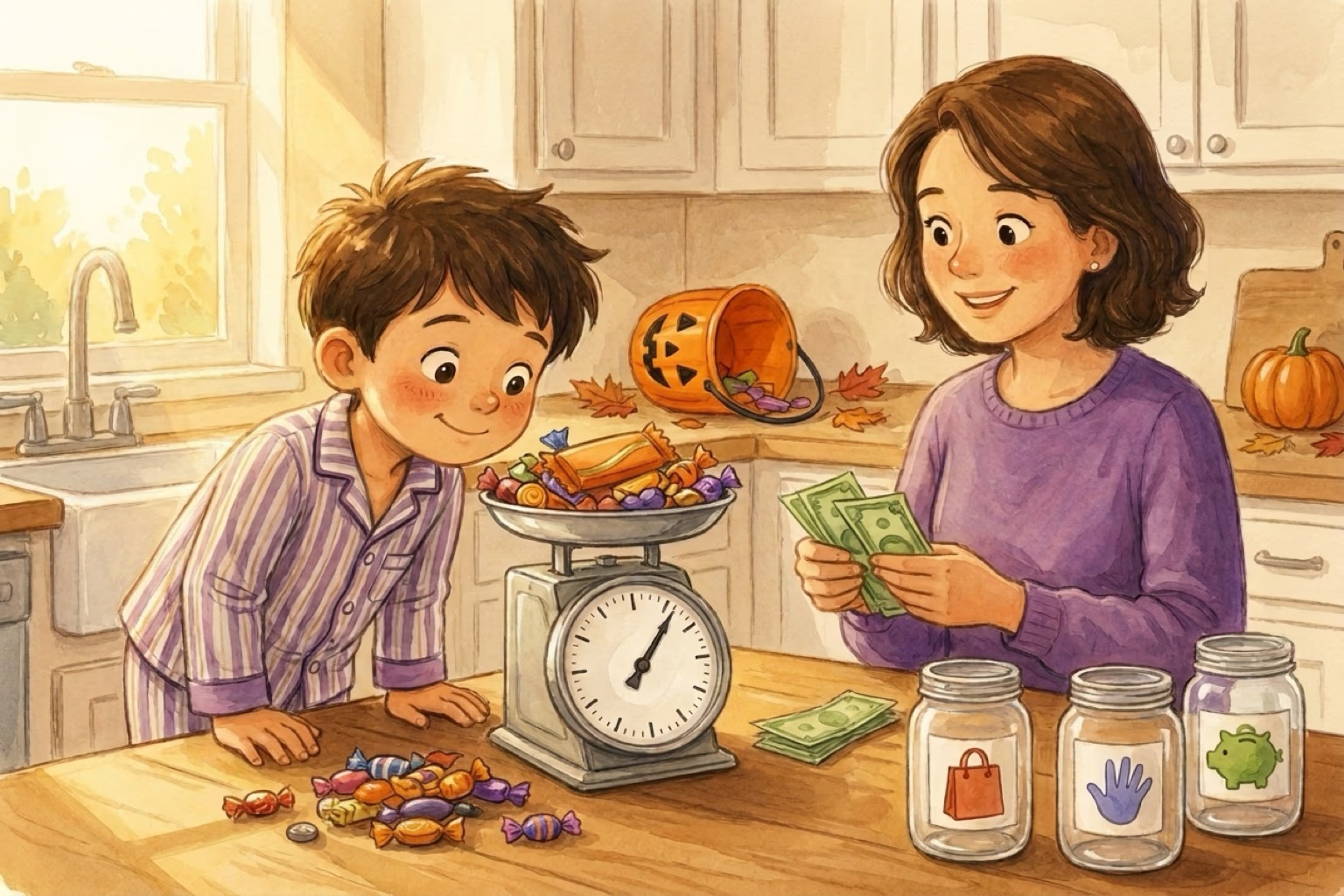
The Halloween Candy Buy-Back: Turn the Candy Pile Into a Money Lesson
It’s November 1. There’s a pile of candy on the kitchen counter, and your kid is guarding it.
You have three classic options. Let the sugar free-for-all run its course. Spend three weeks hiding the bag on top of the fridge. Or throw it out and feel weird about the waste.
There’s a fourth option, and it’s the best trick I’ve found for the week after Halloween: buy the candy back. Turn it into money, then run that money through save, spend and give. The candy problem shrinks, and your kid gets a money lesson you can’t set up any other time of year.
How much Halloween candy is too much?
Start with a number. The American Academy of Pediatrics guideline is no more than six teaspoons (25 grams) of added sugar a day for kids 2 and up. A 2024 report from Lurie Children’s Hospital put that in Halloween terms: about two fun-size pieces of candy a day.
Most parents already know the haul is too much. In that same survey of 1,078 Illinois parents, 67% said they set rules for how much candy their kids can eat each day. The AAP’s own Halloween advice says it plainly: “Try to ration treats for the days and weeks after Halloween.”
Rationing works. It also means three weeks of negotiating. The buy-back skips the negotiating.
How the candy buy-back works
Before trick-or-treating, announce the deal: the Bank of Mom and Dad will buy any Halloween candy you don’t want. The rate is $1 a pound. (Some families pay 25 cents a piece. Pick one and stick with it.)
On Halloween night, before the sugar high turns into a debate, your kid picks a keep pile. Give them a number, like 10 pieces. Those are the favorites they actually want. At two pieces a day, that’s about five days of treats. Everything else is for sale.
On November 1, weigh the sell pile together and pay out. Then split the cash into save, spend and give before it goes anywhere else. If you use Digital Piggy Bank, log the payout as a one-time earning so it lands in your kid’s save, spend and give buckets the same way chore money does.
That’s the whole trick. The lesson isn’t in a lecture. It’s in the choice.
Set the rules before the doorbell rings
Three rules keep this from blowing up:
- Announce the rate before trick-or-treating. If you announce it after, it feels like a heist, not a deal.
- The keep pile is final, in both directions. Ten pieces, their choice, no commentary from you. Once a piece is sold, it’s gone. The first time your kid tries to buy back a sold candy bar, you’ll watch the lesson about waiting and trade-offs land in real time.
- The money goes into save, spend and give. Not into a pocket.
Why unexpected money needs a plan
Candy money is a windfall. Your kid didn’t plan for it, and that matters. In a 1994 study of windfall gains, psychologist Hal Arkes and his colleagues found that people spend unexpected money more readily than money they saw coming. When the researchers handed out real cash, the people who got no warning spent more at a basketball game than the people who’d been told days ahead.
Adults do this with tax refunds and bonuses. Kids do it with candy money and birthday cards. Splitting the payout right away gives the windfall a job before it disappears. (The bigger version of this habit is in our guide to Christmas and birthday money.)
It’s a trade, not a confiscation
Most kids know, on some level, that a giant bag of candy isn’t good for them. You’re not taking it away. You’re making an offer. Taking candy away teaches resentment. A trade teaches negotiation.
Already trick-or-treated? You can still do it
Found this on November 1? You can still run the buy-back. Just make it an offer your kid can turn down.
Say: “I’ll buy any candy you don’t want. A dollar a pound.” Let them build their keep pile first, with no pressure on what goes in it. Then weigh whatever they choose to sell. A trade your kid agrees to is still a trade, even if the offer came a day late. Next year, announce it before the costumes go on.
What to do with the candy you buy back
Plan this part, or you’ve just moved the pile to your own pantry.
- Donate it. Many food pantries and shelters take sealed, wrapped candy. Call first, since rules vary.
- Run a Switch Witch. The Switch Witch takes the sell pile overnight and leaves a small toy. This works best for ages 4 to 6. Your 11-year-old knows it was you.
- Check for a local buy-back. Some dentist offices run Halloween candy buy-back events. If one near you does, let your kid compare offers: who pays more, you or the dentist? That’s a free lesson in shopping around.
How to run the buy-back at every age
- Ages 4 to 6: Skip the math. Use the Switch Witch swap, or pay a few coins they can drop into their jars.
- Ages 7 to 9: Pay $1 a pound. Let them read the kitchen scale and split the money into save, spend and give.
- Ages 10 to 12: Pay per piece. They count, do the math, choose their own split, and set a goal for the save money.
Parent Tip: Ask about the give jar once, right after payout. A kid who just made $6 off candy is in a generous mood. Ask where their give money should go, then let them decide. It’s the cheapest generosity lesson of the year.
Mistakes to avoid
- Announcing the rate after the candy is gone, unless you make it optional like the version above.
- Setting the rate too high. $5 a pound sounds fun and teaches nothing. The rate should feel like real money to your kid without being real money to you. A dollar a pound works for most families.
- Buying back candy they already ate. The keep pile is the keep pile. You’re not paying for wrappers.
Pick your rate now
Decide on a dollar a pound or a quarter a piece, and say it out loud before anyone heads out the door. If you don’t have a save, spend and give system yet, start with the jars. Digital Piggy Bank keeps each kid’s split in one place, so the candy money doesn’t vanish into a jeans pocket.